Quand on les empêche de dormir la nuit, les Poisson zèbreEgalement nommé danio rerio, le poisson zèbre est un petit poisson populaire chez les aquariophiles, originaire des eaux tropicales de l\'Inde. Il mesure entre 2 et 5 centimètres de long, et arbore sur son corps des bandes horizontales bleues et argentées.');" onmouseout="killlink()">poissons zèbres ne récupèrent pas pendant le jour, comme le feraient la plupart des MammifèreClasse de vertébrés comprenant plus de 4000 espèces. Ils se caractérisent entre autres par :
- une température corporelle constante ;
- la possession de poils ;
- le fait d\'allaiter leurs petits ;
- la présence d\'une demi mâchoire inférieure formée d\'un seul os.
Les premiers mammifères...');" onmouseout="killlink()">mammifères. Cette étrange observation s'explique peut-être par une différence dans l'action d'un RécepteurProtéine, généralement située à la surface des cellules, capable de fixer une molécule informative (médiateurs chimiques, neurotransmetteurs, hormones...) et de convertir ce message extracellulaire en signal intracellulaire, entraînant une réponse de la part de la cellule.');" onmouseout="killlink()">récepteur du système nerveux, également impliqué dans la NarcolepsieLa narcolepsie est un trouble neurologique qui se caractérise par des envies rapides et irrépressibles de dormir, pouvant intervenir plusieurs fois dans une seule et même journée. La narcolepsie se manifeste souvent à l\'adolescence et touche deux fois plus d\'hommes que de femmes.');" onmouseout="killlink()">narcolepsie. Mais au fait, pourquoi dort-on ?
http://www.nature.com/news/2007/071016/full/news.2007.167.html
Studies across species could reveal how sleep evolved.
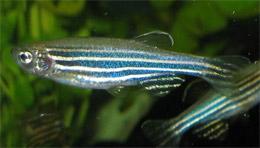
 Zebrafish won't be caught napping after a sleepless night.
Zebrafish don't nap more during daylight hours when sleep deprived, a new study shows. The work suggests that fish are better able to use light cues to stay awake during the day than mammals, hinting that evolution has produced different systems for regulating sleep in different groups of animals.
Every animal sleeps, but many do so in ways that humans would hardly recognize. Cows stand stock still on their four legs; dolphins take a separate nap in each hemisphere of their brains so they can keep swimming. Even fruitflies catch forty winks now and again in their short lives.
The way you can tell a zebrafish is asleep, says Emmanuel Mignot at Stanford University in Palo Alto, California, is that its tail droops, it hangs immobile at the bottom of the tank, and it requires more of a prod - a mild electric current will do - to get it swimming than when it is awake.
Mignot and his colleagues are keen to keep zebrafish awake to study how sleep - or the lack of it - affects this often-studied fish. No one really understands why people sleep; how sleep evolved is equally mysterious, says Mignot. "Sleep is one of the basic mysteries remaining, in terms of why it has been selected for." To understand that, he is studying sleep in animals from dogs to zebrafish. "It is better to understand how we sleep across evolution, and then we will understand the reason for sleep," he says.
The team found that if you keep zebrafish awake all night and then leave the lights off, they will make up for lost snoozing time. But if you keep them awake and then flip on the lights, they won't nap more during the next day, as mammals would1.
To find out what was causing this behaviour, Mignot and his colleagues looked at what happens when a mutation knocks out the only receptor for the sleep neuropeptide hypocretin (also known as orexin) in the zebrafish.
In mammals, such a gap in the hypocretin system causes narcolepsy, a syndrome featuring crushing daytime sleepiness and night-time insomnia as well as bouts of muscle collapse called cataplexy. But in the fish, this seems to cause only the night-time insomnia.
Mignot says he thinks that light and the hormone it triggers - melatonin - suppress sleep in the fish so strongly, they overrule any 'sleep debt' from the night before. Unlike mammals, they only need their hypocretin system to regulate sleep at night. Physiological studies support this theory. Some birds seem to behave the same way, Mignot adds, hinting that light and melatonin-dominated day regulation might span the non-mammalian animal family tree.
"I do believe the role of light and melatonin came to a kind of crossroads. At some point it became less effective, and animals had to develop a different way to promote wakefulness," says Mignot.
The finding contradicts previous work that has found that hypocretin increases wakefulness during the day as well as at night in zebrafish - though this was in larvae rather than adults. "Further analysis of hypocretin-receptor mutants is needed to resolve these discrepancies," says Alexander Schier of Harvard University in Cambridge, Massachusetts, one of the authors of the previous study.
He says he would like to see much more work done across the animal kingdom, to create an evolutionary tree of sleep. He's going to stick with his zebrafish for now, he adds, but he would love to study the same system in an animal such as a platypus - from the most ancient and reptile-like family of mammals. "I would dream to do this in a monotreme, to find out if we could have a narcoleptic platypus."
The narcoleptic dogs, incidentally, are no longer an active area of research - the dogs have all been retired into private life. "We have one last dog, and he was just adopted," says Mignot. "He's now mine."


/https%3A%2F%2Fassets.over-blog.com%2Ft%2Fcedistic%2Fcamera.png)