Published online: 11 June 2007; | doi:10.1038/news070611-2
Stem cells help primates with Parkinson's
Monkey studies highlight multiple stem cell abilities.Helen Pilcher
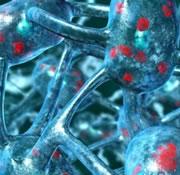

| Stem cells can both turn into neurons and help neurons to grow. DAVID MACK / SCIENCE PHOTO LIBRARY |
|
Human
stem cell transplants have eased the symptoms of Parkinson's disease in
a monkey model of the brain disorder. The study, which brings the
prospect of human trials one step closer, hints that stem cells do more
than just replace cells - they may help persuade the brain to heal
itself.
Parkinson's
disease, which affects around 1 in 500 people, destroys nerve cells
that produce the chemical dopamine, leading to movement and balance
problems. Most treatments attempt to boost dopamine levels through
drugs, but the results can be patchy and short-lived. So the hope is
that stem cells - primitive cells that can produce many other cell
types - may offer a more permanent solution.
In the current study, published in
Proceedings of the National Academy of Sciences1,
researchers isolated stem cells from the brains of aborted fetuses and
grew them into large numbers in the laboratory. The cells were then
injected into the brains of monkeys with a severe form of chemically
induced Parkinson's disease.
Before
the treatment, the animals couldn't walk unaided, struggled to use
their hands and were sometimes unable to move at all. But two months
afterwards, they could walk, feed themselves and move more normally.
"They're not as good as normal monkeys, but the improvement is still
dramatic," says team-member and neuroscientist Richard Sidman from the
Harvard Institutes of Medicine, Boston, Massachusetts.
Take twoThere
have been a large number of successful studies showing that human and
rodent stem cells can help rats with a version of the disease get
better. But the field was hit by a major setback when human trials of
transplanted fetal brain tissue in the mid-1990s left some Parkinson's
patients with uncontrollable, jerky movements. Since then, a lot of
work has gone into culturing and purifying stem cells.
Paul
Sanberg from the University of South Florida College of Medicine,
Tampa, who was involved in the early human trials, points out that the
new treatment works well in extremely ill monkeys, so it may work even
better in milder cases or early stages of the disease. And unlike some
other stem cells, which have had growth-promoting genes added in or
been derived from day- rather than week-old embryos, these cells appear
not to form tumours after transplant. That should ease worries about
the safety of stem-cell treatment.
Support teamBut
perhaps most surprising is how the transplanted cells did their job.
Only a minority of stem cells turned into dopamine-producing neurons -
not enough to replace all the neurons that had been lost to disease.
Instead, some of the stem cells turned into astrocytes, a supportive
brain cell known to produce neuron-nourishing chemicals. The team
spotted a host of large, dopamine-producing neurons in the brains of
transplant recipients that weren't directly derived from stem cells.
It's thought that stem cells may churn out molecules that boost nerve
survival and blood-vessel development, and decrease inflammation and
neurodegeneration - helping the host brain to help itself.
"People
used to think that stem cells transplants would work by replacing
missing cells," says neuroscientist John Sinden from the UK stem-cell
company ReNeuron. "But these results suggest they may do more than
that. They may actually switch on the brain's own innate repair
mechanisms."
"It's becoming clear that transplanted neural stem cells
exert their behavioural effects through a series of mechanisms," agrees
study contributor and stem-cell biologist Evan Snyder from the Burnham
Institute for Medical Research, California. "There's a whole network of
activity and crosstalk."
The intriguing results mean there is much more basic research to be done before moving to clinical trials, says Snyder.
References : Redmond D. E.,
et al. Proc. Natl Acad. Sci. USA, advance online publication, 11 June 2007 (doi: 10.1073/pnas.0704091104).


/https%3A%2F%2Fassets.over-blog.com%2Ft%2Fcedistic%2Fcamera.png)