Published online: 25 June 2007; | doi:10.1038/news070625-4
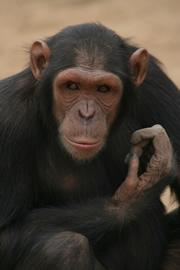
Is it a chimp-help-chimp world?
Clever experiment shows altruism in great apes.Kerri Smith
Humans
are often thought of as the only truly altruistic species. We help
others out - by giving blood, donating to the poor, or committing to
recycling - for no immediate payoff, and often at a cost to ourselves.
But
evidence is gathering that we might not be alone. Felix Warneken and
colleagues at the Max Planck Institute for Evolutionary Anthropology in
Leipzig, Germany, have shown that chimpanzees will do favours for
unrelated chimps - even when they do not get rewarded for it.
Previous
studies have refuted the idea that chimps are so giving. In 2005,
anthropologist Joan Silk of the University of California, Los Angeles,
found that when she presented chimps with the choice of getting food
just for themselves, or for their entire group, they showed no
preference for feeding their pals as well.
But other work has shown that chimps can have a non-selfish streak. In a study published in
Science last year,
a Leipzig team reported that chimps would help their human keepers
retrieve a pen that they had dropped - an action with no direct benefit
for the chimp.
That
study involved chimps helping out human carers whom they were familiar
with - and who had on other occasions provided the chimps with food. To
get rid of these complications, the Leipzig team replicated the
pen-dropping experiment with unfamiliar humans. As they now report in
PLoS Biology, the chimps still chose to help out.
Let me at that bananaThe
team did another experiment too, to clarify whether chimps would be
altruistic to others of their own kind without a scent of reward. They
placed one chimpanzee in a room with a closed door leading to some
bananas that it had seen, and a second chimp in a position where it
could not see the bananas, but could open the door. When the first
chimp struggled to open the door, the second chimp watching the
struggle (but unaware of the reason for it), would pull a chain to open
the door. In trials, chimps would help out a struggling mate nearly 80%
of the time, even without knowing that food was involved.
Warneken
suggests that this clever experimental setup proves what he and others
already thought chimps were capable of, but hadn't been able to
demonstrate before. "We should move away from the question 'is altruism
there?' to the question 'under what circumstances do chimps display
this behaviour?'," he says.
Silk
says she's impressed with the experiment. "This raises a bunch of
questions about the context and the motivation of chimps to behave in a
way that is beneficial to others," she says. "What does this mean to
them?"
Young and sweetBut Silk notes that the results still might not show true
altruism that exists across the species. She wonders, for example,
whether there is something special about these chimps and how they have
been raised since their capture from the wild. She would like to see
the experiment done with other chimps - or for these chimps to have a
go at her experiment.
She
also wonders whether the age of the chimps makes a difference. Whereas
Warneken's group worked with young chimps, Silk's experiments used
older animals. Chimps might get more selective in who they help as they
age, she suggests.
Warneken
is convinced that his experiments offer proof of chimp altruism. And if
chimps can do it, the roots of the tendency in our own species might go
deeper than previously assumed. "Culture and education are not the only
origin of these altruistic tendencies," says Warneken. Human society,
he says, has cultivated a trait that was already present, rather than
inventing it anew.
References- Silk J., et al. Nature, 437. 1357 - 1359 (2005).
- Warneken F.& Tomasello M. Science, 311. 1301 - 1303 (2006).
- Warneken F., et al. PLoS Biology, 5. e184 (2007).
Published online: 3 July 2007; | doi:10.1038/news070702-4 / http://www.nature.com/news/2007/070702/full/070702-4.html
Generosity among rats
Rats do unto others as they have been done to.Louis Buckley


| A helping paw: rats are more generous when another rat has helped them out. Punchstock |
|
Rats that benefit from the charity of others are more likely to help strangers get a free meal, researchers have found.
This
phenomenon, known as 'generalized reciprocity', has only ever been seen
before in humans. A good example, says Michael Taborsky of the
University of Bern, Switzerland, is what happens when someone finds
money in a phone box. In controlled experiments such people have been
shown to be much more likely to help out a stranger in need following
their good luck.
In
humans, such benevolence can be explained by cultural factors as well
as by underlying biology, says Taborsky. But if similar behaviour can
be found in other animals, he reasons, an evolutionary explanation
would be far more likely.
To
test for this behaviour in animals, Taborsky trained rats to pull a
lever that produced food for its partner, but not for itself. Rats who
had received a free meal in this way were found to be 20% more likely
to help out an unknown partner than rats who had received no such
charity
1.
Taborsky
believes this behaviour isn't confined to just rats and humans. "I'm
convinced generalized reciprocity will be very widespread and found in
many different animal species, as our study suggests that an underlying
evolutionary mechanism is responsible."
"Generalized
reciprocity is certainly underappreciated in animals," notes Laurent
Keller, an evolutionary biologist at the University of Lausanne,
Switzerland. But with so little data in this area, he adds, "it is very
difficult to make predictions about how prevalent it's likely to be."
Survival of the friendliestExplaining
why animals cooperate has long been a tricky area for evolutionary
biologists. According to darwinian evolution, organisms are adapted to
maximize their individual chances of survival, so how is it possible to
account for acts of charity?
Among family members, it makes sense for one animal to help another in order to help their shared genes to get on in the world.
But
when it comes to helping non-family members, things are more
complicated. It might make sense for one animal to help another in
exchange for receiving help themselves later on. But this is open to
abuse by cheats who are happy to take, but not to give in return.
Highly
intelligent animals - including humans - can judge whether or not to
give help based on the individual track record of a specific potential
partner. But this kind of 'direct' reciprocation between two
individuals only happens under restricted conditions, says Taborsky.
"Animals have to meet frequently and have to remember what other
individuals have done and how they acted in the past. That means
animals have to possess high cognitive abilities. And for these reasons
it hasn't been demonstrated very often."
Another
strategy, called 'generalized reciprocity', is for an animal to assume
that its most recent interaction with any other individual is
representative of how the whole community usually behaves. In that
case, an animal only has to remember its last experience. "It's a
simpler mechanism and therefore more likely to be evolutionarily
important," says Taborsky.
Not-so-dirty ratsTaborsky
thinks he has seen both types of reciprocity in his rats. In addition
to being 20% more likely to help out an unknown partner if they had
received a bit of charity, his study shows that rats were more than 50%
more likely to help a specific rat who had helped them in the past
1.
Taborsky
thinks that it is likely that the two forms of reciprocity work
together. If an animal can remember how generous another individual is
it will use this information to decide whether it's wise to cooperate.
But if not, then it can base its decision on more general recent
experience - how helpful other animals have been towards it in the
recent past.
Other researchers point out that because rats typically
live in family groups, it's hard to discount the idea that they're just
trying to help their relatives out.
"What
we need to understand now is the physiological and neurological
mechanisms responsible," says Taborsky. He suspects that hormonal
changes in response to charity might be behind the tendency to
cooperate. "We are going to look at hormonal regulation, and we're also
looking at other animals - cichlid fish at the moment."
Reference : Rutte, C. & Taborsky, M. PLoS Biol.
5
,
e196
(2007).




/https%3A%2F%2Fassets.over-blog.com%2Ft%2Fcedistic%2Fcamera.png)